
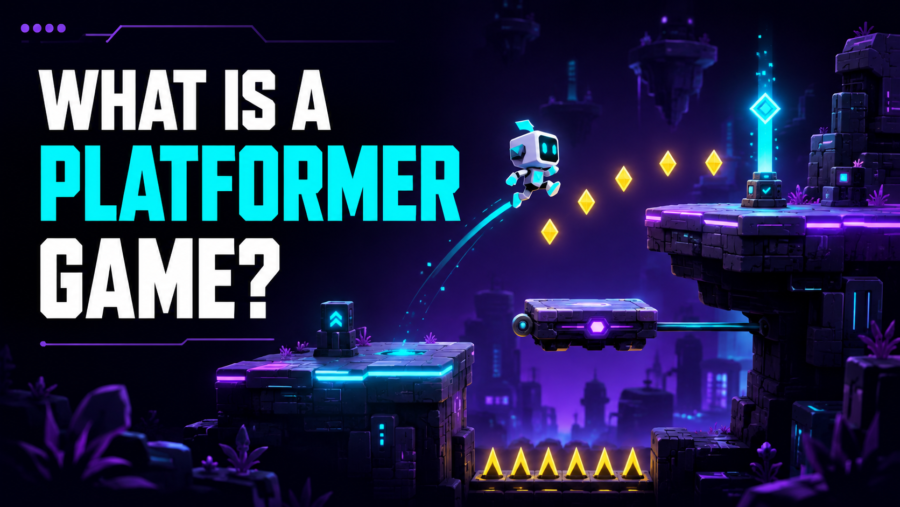
A platformer is a game centered on moving a character through an environment made of floors, ledges, gaps, platforms, hazards, and changes in height. Running and jumping are the most familiar actions, but climbing, swinging, bouncing, wall movement, gliding, and other traversal abilities can also define the route.
The genre is identified by what the player must master: position, movement, timing, and the shape of the level. A game does not become a platformer merely because a character can jump once.
The Core Platformer Loop
A typical platforming sequence asks the player to:
- Read the terrain and identify a route.
- Move toward a platform, gap, or obstacle.
- Time an action such as a jump or climb.
- Adjust position while moving, if the controls allow it.
- Land safely or reach the next surface.
- Repeat the process with new hazards or movement combinations.
The level itself creates the challenge. Distance, height, momentum, enemy placement, moving surfaces, and limited safe space all affect the same basic movement system.
Why Jumping Is So Important
Jumping lets the player cross gaps, reach higher ground, avoid hazards, and interact with enemies or objects. Because a jump temporarily removes direct contact with the ground, it creates a commitment: the player must predict where the character will travel and land.
The exact feel depends on several design choices:
- Initial jump speed
- Gravity or downward acceleration
- Horizontal acceleration
- Maximum movement speed
- Air control
- The ability to shorten a jump by releasing the button
- Collision size
- Landing behavior
Two games can use the same buttons yet feel completely different because those values and rules differ.
Jumping is central to most platformers, but a broader traversal system can sometimes fill the same role. A game focused on climbing between surfaces or moving through vertical obstacles may still use platforming structure without a conventional jump button.
What Is Air Control?
Air control is the player’s ability to change horizontal movement after leaving the ground. Strong air control allows large corrections during a jump. Weak air control makes the takeoff direction and speed more important.
Neither approach is automatically better. Strong control can make experimentation forgiving, while limited control can reward careful preparation and momentum. The level must be built for the chosen movement rules.
Jump Arcs and Variable Jump Height
A jump arc is the path a character follows from takeoff to landing. It usually rises, slows near the top, and accelerates downward.
Some games use a fixed arc. Once the player jumps, the duration and height change very little. Others use variable jump height, where holding the input produces a higher or longer jump and releasing it early produces a shorter one.
Variable height gives one button several uses. A short tap can clear a small hazard without overshooting, while a longer hold can reach a high ledge.
Platforms, Gaps, and Hazards
A platform is any surface that supports movement or landing. It can be stationary, moving, falling, rotating, temporary, or affected by the player’s actions.
Gaps create a clear test of distance and timing. Hazards add another rule to the space. A hazard may cause damage, remove a life, reset the player to a checkpoint, or end the attempt.
Readable levels show where the player can stand and what must be avoided. Visual decoration should not make a safe platform look dangerous or a hazard look harmless unless uncertainty is an intentional mechanic.
Checkpoints, Lives, and Restarts
Failure rules shape the pace of a platformer.
- A checkpoint records a recent position and restarts the player nearby.
- A life system allows a limited number of failures before a larger reset.
- An instant restart returns the player quickly to the current challenge.
- A full restart sends the player back to the beginning of a level or run.
Short, precise challenges often benefit from fast restarts because the player can immediately apply what was learned. Longer levels usually need checkpoints to avoid repeating too much completed movement.
Limited lives and score attacks are closely associated with classic arcade mechanics, but modern platformers can use many other progression structures.
Collectibles and Optional Routes
Collectibles can mark a route, reward exploration, add score, unlock content, or create a harder optional objective.
Their placement communicates intent. A line of simple pickups may show the expected jump arc. A collectible above a dangerous gap may invite an advanced route. A hidden item may reward noticing an unusual wall or platform.
Optional routes let different players pursue different goals. Reaching the exit can remain the main objective while complete collection, fastest time, or fewest mistakes provides an additional challenge.
Common Platformer Subgenres
Action Platformers
Action platformers combine traversal with attacks, enemies, projectiles, or other combat. Movement remains central, but the player must manage threats while navigating the level.
Puzzle Platformers
Puzzle platformers use movement to solve spatial problems. The player may move objects, activate switches, change the environment, or determine the correct order of actions.
The challenge can still require precise movement, but understanding the route is as important as executing it.
Precision Platformers
Precision platformers emphasize exact timing, control, and repeated attempts. Small safe areas, demanding jump sequences, and quick restarts are common.
Endless Runners
An endless runner moves the character or environment continuously. The player jumps, changes lanes, slides, or avoids obstacles while the run becomes faster or more complex.
Not every runner is a platformer, but many use platforming principles because the challenge depends on traversal and landing.
Exploration Platformers
Exploration-focused platformers connect movement abilities to access. A new jump, climb, dash, or movement tool can open routes that were previously unreachable.
2D vs 3D Platformers
A 2D platformer usually restricts movement to a flat plane, even if the artwork creates an illusion of depth. The player mainly reasons about horizontal and vertical position.
A 3D platformer adds movement through depth. Camera position becomes important because the player must judge where a character and landing surface sit in three-dimensional space.
The core focus can remain the same: move through an environment by mastering traversal. The extra dimension changes navigation, camera control, and distance judgment.
Platformers vs Point-and-Click Games
In a platformer, the player usually controls movement directly and must execute the route. In a point-and-click game, selecting a destination often causes the character to travel there automatically.
A hybrid can alternate between both systems. The genre label depends on which actions carry the main challenge.
Are Platformers Always Fast?
No. Some demand rapid reactions, while others encourage careful observation and slow puzzle solving. A platformer can even use low-pressure movement and forgiving failure rules.
Relaxing game mechanics explains how pace, punishment, audio, and player control can change the emotional pressure without changing the basic genre.
Platformer Controls in a Browser
A browser platformer may use a keyboard, mouse, controller, touchscreen, or a combination. The HTML5 label does not guarantee any particular control method.
Keyboard focus can matter in an embedded game. The player may need to click inside the game before arrow keys or the spacebar are recognized. If input or graphics fail, use the steps in Browser Game Not Loading Fixes.
Touch controls require more than placing buttons on the screen. Button size, spacing, simultaneous input, screen orientation, and the need to see the landing area can all affect playability.
Single-Player and Multiplayer Platformers
Platforming describes movement, not the number of players. A game can be single-player, cooperative, competitive, local multiplayer, or online multiplayer.
In co-op, players may share a route, activate mechanisms for each other, or recover from mistakes. In competition, they may race, collect more points, or try to remain active longer. The game modes guide explains those distinctions.
Frequently Asked Questions
Does a platformer have to include jumping?
Jumping is the genre’s most common action, but another traversal system can sometimes create the same platform-based challenge. The level must still center on movement through uneven spaces and surfaces.
Is every game with a jump button a platformer?
No. Jumping can be a minor action in many genres. It must be central to navigation or challenge for the platformer label to be useful.
What is a moving platform?
It is a surface that changes position while supporting or transporting the character. The player may need to time entry and exit or compensate for its movement.
What is a checkpoint?
A checkpoint is a saved restart position within a level or sequence. It reduces how much completed play must be repeated after failure.
Are endless runners platformers?
Many are, especially when jumping, landing, and avoiding gaps define the challenge. Some runners focus on lane changes or obstacles without meaningful platform navigation.