
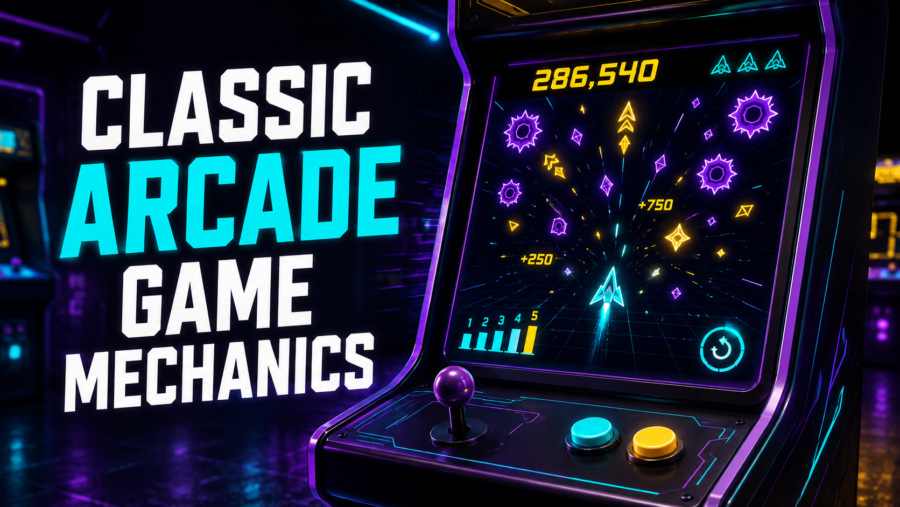
Classic arcade games were shaped by a specific environment: public machines, fixed controls, short sessions, visible scores, and a need to explain themselves quickly. Their graphics varied widely, but their most recognizable qualities came from design decisions rather than pixels alone.
The result was a style built around immediate action, readable goals, escalating pressure, and the desire to improve one more score. Those mechanics still appear in modern browser games because they work well in short, repeatable sessions.
What Counts as a Classic Arcade Game?
“Arcade game” originally described a game played on a dedicated machine in a public venue. The cabinet, display, controls, and payment system formed one product. Players usually stood or sat at the machine and paid for a limited attempt.
Today, the term can also describe games that imitate the structure of those experiences. A modern arcade-style game may run in a browser and never accept a coin, yet still use a score-driven loop, limited mistakes, simple controls, and rapidly increasing difficulty.
That means “classic arcade” can refer to three related ideas:
- A game originally made for a coin-operated cabinet
- A game from the early commercial arcade era
- A newer game designed around recognizable arcade mechanics
These meanings overlap, but they are not identical. Retro artwork alone does not make a game arcade-style, and an arcade-style ruleset does not require old graphics.
The Core Arcade Gameplay Loop
A classic arcade loop is usually easy to state:
- Understand the immediate objective.
- Act with a small set of controls.
- Earn points or survive a challenge.
- Face greater speed, density, or complexity.
- Lose a life or end the run after enough mistakes.
- Start again with better knowledge and execution.
The full game may contain many patterns and hazards, but the first meaningful action arrives quickly. Long introductions and complicated setup work against the short-session environment in which arcade design developed.
Why Scores Matter So Much
Scores turn a brief run into a measurable performance. Even when a game has no final ending, the number records how far the player progressed and how effectively they handled risk.
A strong scoring system does more than count time. It rewards particular actions and therefore teaches the player what the game values. Extra points might come from accuracy, speed, consecutive successes, harder targets, or collecting a risky bonus.
This creates several layers of play:
- A new player tries to survive.
- A returning player tries to beat a personal score.
- An advanced player studies routes, timing, and scoring opportunities.
Lives, Mistakes, and Continues
Many classic arcade games give the player a limited number of lives or chances. A mistake removes one life, resets part of the playfield, or ends the current run.
Lives make failure easy to understand. They also let a player recover from an early error without making the session endless. An extra life can act as a clear milestone reward, often tied to score or progress.
A continue system changes the meaning of failure. Instead of restarting from the beginning, the player may resume near the point of defeat. This can make later content easier to reach, but a continued run may be tracked differently from a single-credit or no-continue performance.
Modern games do not need to copy either system exactly. The important design question is what a mistake costs and how quickly the player can try again.
Escalating Difficulty
Classic arcade games often become harder through controlled escalation. Common methods include:
- Faster movement
- More enemies or targets
- Shorter reaction windows
- Denser hazards
- New behavior patterns
- Fewer safe spaces
- Higher accuracy requirements
- Longer sequences between recovery points
Good escalation preserves the basic rules while demanding better execution. The player is not relearning the entire game every minute. Instead, familiar actions become harder to perform under pressure.
Difficulty can increase continuously or in stages. A wave structure creates clear pauses and milestones. A continuous structure raises pressure without a formal break. Tower defense games also use waves, but they shift more of the challenge from reflexes toward placement, resource use, and preparation.
Simple Controls, Deep Decisions
Arcade cabinets have fixed physical controls. A machine might provide a joystick, a few buttons, a steering wheel, a trackball, or another specialized input. The player cannot remap a public cabinet before every short attempt.
This encouraged control schemes that could be understood quickly. Simplicity did not eliminate depth. A single movement control and one action button can still create difficult decisions about timing, position, target priority, and risk.
The same principle helps browser games. A compact control set reduces the time between opening a page and understanding the first action. It also makes a restart feel inviting instead of burdensome.
Readable Playfields and Immediate Feedback
Arcade play happens in visually busy public spaces, often with people watching. Important objects must be recognizable at a glance.
Clear feedback helps the player connect an action to its result. Useful signals include:
- A visible score increase
- A distinct sound for success or danger
- A brief flash or animation after a hit
- A clear life or health indicator
- Consistent colors or silhouettes for different hazards
- An obvious transition between waves or stages
Feedback should reveal what happened without hiding the next decision. Too many effects can make the playfield harder to read, especially as difficulty increases.
Pattern Learning and Controlled Uncertainty
Many arcade challenges combine repeatable patterns with uncertain timing or positioning. Patterns reward memory and practice. Variation prevents every run from becoming identical.
Too much predictability can turn play into a fixed script. Too much randomness can make improvement feel unrelated to skill. Effective designs give the player enough consistency to learn while preserving the need to react.
This balance is one reason short arcade loops can support repeated play. The rules remain stable, but the player notices new relationships between movement, timing, and risk.
Attract Modes and Fast Explanations
A cabinet that is not being played often displays an attract sequence. It may show a demonstration, title screen, high-score table, or brief instruction panel. Its job is to explain the appeal from a distance and invite the next player.
The same idea survives in modern interfaces. A short animation, clear objective, visible controls, or useful start screen can answer the player’s first questions before the run begins.
An effective introduction explains:
- What the player controls
- What the immediate goal is
- What causes failure
- How points or progress are earned
- Which input starts the game
It does not need to reveal every advanced rule at once.
Single-Player and Multiplayer Arcade Structures
An arcade cabinet can support several participation models. Two players might compete at the same time, take alternating turns, cooperate toward a shared objective, or compare separate scores.
These structures are not interchangeable. Alternating turns are not simultaneous multiplayer, and a shared score does not automatically mean both players have equal control. Game Modes Explained separates single-player, local multiplayer, co-op, competitive, and 1v1 play.
The public setting also made score comparison social even in a single-player game. A player could compete with previous scores without another person being present during the run.
How Platformers Use Arcade Design
Early platform games adopted many arcade principles: direct movement, limited lives, visible scoring, fast failure, and stages that demanded increasingly precise timing.
Platforming adds a particular focus on spatial movement, jumping, landing, and hazards. The genre can now include exploration, stories, checkpoints, and long campaigns, so not every platformer follows a short arcade loop. What Is a Platformer Game? explains which movement mechanics define that genre.
Classic Arcade Style vs Retro Style
Retro style is primarily an aesthetic description. Pixel art, limited color palettes, electronic sound effects, and low-resolution interfaces can make a game look older.
Arcade style is primarily structural. It concerns the play loop, controls, failure rules, scoring, pacing, and replayability.
A game can therefore be:
- Retro-looking but built around a long, slow campaign
- Modern-looking but driven by short score attacks
- Both retro-looking and arcade-structured
- Neither
Separating appearance from mechanics makes the term more useful.
Why Arcade Mechanics Still Fit Browser Games
Browser play favors quick access. A visitor can open a page, understand a compact objective, play a short run, and restart without managing a large installation.
Arcade mechanics fit that context because they reduce setup and make repetition meaningful. A score, wave number, time, or accuracy result gives each short session a clear outcome.
This does not mean every browser game should be fast or difficult. Point-and-click games can emphasize observation and puzzle solving, while incremental games can make long-term growth more important than reflexes. Arcade design is one useful structure among many.
Frequently Asked Questions
Are all old games arcade games?
No. Many older games were designed for home computers, consoles, handheld devices, or other formats. Age alone does not identify an arcade game.
Does an arcade game need a high score?
No, but score-driven play is one of the most recognizable arcade conventions. Some arcade games emphasize completion, time, competition, or another result.
Are arcade games always difficult?
Not always. Many increase difficulty quickly, but difficulty depends on the exact rules, controls, and progression. A simple opening can coexist with a demanding later game.
Is pixel art required?
No. Pixel art is a visual style. Arcade mechanics can be presented with hand-drawn, vector, 3D, or other graphics.
What makes an arcade-style game replayable?
Fast restarts, understandable rules, measurable results, and room for improvement all encourage another attempt. Variation and escalating pressure can keep repeated runs from feeling identical.