
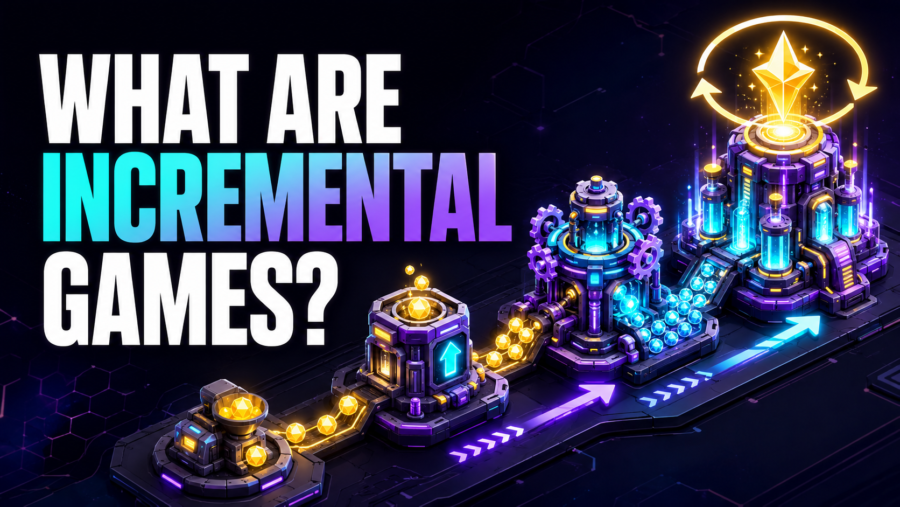
Incremental games are games built around repeated growth. The player generates a resource, spends it on upgrades or producers, and uses those improvements to generate resources faster. Progress is often expressed through numbers that rise from small amounts to extremely large values.
Clicker and idle games belong to the same broad family, but the terms emphasize different parts of the loop. A clicker game highlights active repeated input. An idle game allows meaningful progress with little or no continuous input. Many incremental games combine both.
The Core Incremental Game Loop
The basic loop has four steps:
- Produce a resource.
- Spend that resource on an upgrade, generator, or unlock.
- Increase the rate of production.
- Repeat the process at a larger scale.
The important word is “incremental.” Each purchase changes what the player can produce next. Progress comes from improving the system, not only from repeating the same action at the same value.
At the beginning, one click might create one unit. Later, automated producers may generate thousands or millions of units per second. New layers can introduce additional resources, multipliers, or decisions about where growth should be invested.
Incremental vs Clicker vs Idle
The labels overlap, but they are not perfect synonyms.
| Term | What it emphasizes |
|---|---|
| Incremental game | Growth through repeated upgrades and increasing production |
| Clicker game | Active input, often clicking or tapping to produce or accelerate resources |
| Idle game | Automation and progress that continues with limited player attention |
A clicker can become idle after automation is unlocked. An idle game can still ask for active decisions about upgrades, timing, and resource allocation. “Incremental” is the broadest description because it focuses on the expanding progression system.
This is different from a point-and-click game, where clicks select objects, locations, dialogue, or puzzle actions in a scene.
Active Production
Active production directly rewards the player’s input. Clicking, tapping, holding a control, or completing a short action adds resources.
This phase gives immediate feedback and teaches the value of the first resource. It also creates early decisions: should the player improve the value of each click or save for an automated producer?
Active input does not have to remain the strongest source forever. Many incremental systems gradually shift the player’s role from direct production to planning and optimization.
Automated Production
Automation creates resources without a separate input for every unit. The player might buy a generator, worker, machine, or abstract production level. Each one contributes a rate such as units per second.
Automation changes the central question from “How quickly can I click?” to “Which purchase improves the system most?” That shift is a defining feature of many idle designs.
Automation can also unlock in stages. One system may generate the main currency, another may improve the first system, and a later layer may automate earlier purchases.
Upgrades, Producers, and Multipliers
Incremental games commonly separate several kinds of growth:
- Producers add a recurring amount of resource.
- Upgrades improve clicks, producers, or another rule.
- Multipliers scale an existing amount or rate.
- Unlocks introduce a new system, resource, or decision.
- Milestones reward reaching a stated threshold.
These changes can combine. If a producer makes 10 units per second and an upgrade doubles its output, the new rate becomes 20. A later multiplier can apply to that improved total.
The order of operations matters when several effects interact. A well-explained interface shows what a purchase changes and how the displayed rate was calculated.
Why Costs and Rewards Grow So Quickly
If production rose but costs stayed flat, every later purchase would become trivial. Incremental games often raise prices each time an item is bought, forcing the player to compare the next cost with the increase in output.
Growth may be linear, multiplicative, exponential, or a mixture. The exact formula matters less to ordinary play than the relationship between cost and benefit.
A useful comparison is payback time. If an upgrade costs 1,000 units and adds 100 units per second, it earns back its cost in about 10 seconds before considering other effects. Another purchase may have a longer payback but unlock a powerful new layer.
This creates strategy even when the visible action is simple.
What Is a Prestige Reset?
Prestige is a voluntary reset that removes some current progress in exchange for a lasting advantage. The player starts an earlier part of the game again, but with a multiplier, new currency, permanent upgrade, or additional system.
Prestige creates progress across multiple runs. The immediate loss is accepted because the next run can move faster or reach a new threshold.
Not every reset is prestige. A normal restart may erase progress without a lasting reward. A seasonal reset may begin a new event. A daily reset may replace a challenge. The defining feature of prestige is the persistent benefit carried into the new run.
When Should a Player Prestige?
There is no universal timing rule. The decision depends on what the reset awards, what it removes, and how long the next target would take without resetting.
Useful questions include:
- How much permanent improvement will the reset provide?
- How quickly can the current progress be rebuilt?
- Is a major unlock close enough to justify waiting?
- Does the game reward longer runs or frequent resets?
- Will any limited-time progress be lost?
A clear game should preview the reset reward and identify what will remain. Resetting without that information turns a strategic decision into a guess.
Offline Progress Is Not Guaranteed
An idle label does not automatically mean that progress continues while the game is closed. Several models are possible:
- Production stops when the page closes.
- The game calculates elapsed time when the player returns.
- Progress continues for a limited number of hours.
- Offline output is reduced compared with active output.
- An account or server records time and production.
The exact behavior must be verified in each game. A browser can suspend an inactive tab, discard it to save memory, or clear temporary private-session data. The game may calculate offline rewards from a saved timestamp rather than literally running in the background.
HTML5 game storage and browser behavior explains why closing a page, changing browsers, and clearing site data can affect local progress.
Large Numbers and Number Formats
Incremental growth can exceed the space available for ordinary numbers. Games may abbreviate values with letters, use scientific notation, or introduce named tiers.
The display should remain consistent. If one screen shows 1.5 million and another shows 1,500,000, the values are equal even though the formatting differs.
Rounding can also hide a small change. A visible total of 1.50 million might increase internally while the display remains at 1.50 until it crosses the next rounding threshold.
Bottlenecks and Progress Walls
A bottleneck occurs when one resource, upgrade, or requirement limits further growth. The player may need to rebalance production, unlock a multiplier, complete a milestone, or perform a reset.
Not every slow period is an error. A progress wall can signal that the current strategy has reached its limit. However, a well-designed wall gives the player meaningful options rather than only demanding a long wait.
Common responses include:
- Reallocating resources
- Comparing upgrade efficiency
- Improving an earlier producer that feeds a later one
- Activating a temporary boost
- Reaching a milestone
- Prestiging for a permanent advantage
Do Incremental Games Have an Ending?
Some have a final objective or narrative conclusion. Others continue through repeating upgrades, new numerical scales, challenge modes, or periodic content.
“Endless” should not be assumed. Even a game with very large numbers can have a final unlock, a practical content limit, or a point where no further systems are available.
Failure also varies. Many incremental games do not have a traditional game-over state. The consequence of a poor decision may simply be slower growth. Other designs add timed challenges, limited attempts, or competitive goals.
Daily Systems in Incremental Games
An incremental game may use daily rewards, rotating tasks, or streaks to structure return visits. Those systems are separate from ordinary resource production.
A daily reward might reset at a fixed server time, at local midnight, or after a rolling interval. Missing a day may break a streak, pause it, or have no penalty.
Are Incremental Games Single-Player?
Many focus on one player’s progression, but the genre does not require a particular mode. Rankings, shared goals, trading, competition, or cooperative systems can be added.
A leaderboard alone does not make the underlying production loop multiplayer. The game modes guide explains the difference between direct player interaction and score comparison.
Frequently Asked Questions
Are all incremental games clicker games?
No. Some use clicking as their main early action, while others begin with menus, timed production, movement, or resource choices. Incremental growth is the broader requirement.
Are clicker games and point-and-click games the same?
No. Clicker games use repeated input to generate or accelerate resources. Point-and-click games use a pointer to inspect scenes, navigate, and solve puzzles.
Does an idle game keep running when the browser is closed?
Not necessarily. It may calculate elapsed time when reopened, apply a limited offline reward, or stop entirely. Check the exact rules.
What is prestige currency?
It is a resource awarded through a prestige reset and usually spent on benefits that survive later runs. The exact name and permanence depend on the game.
Why do incremental games use huge numbers?
Their upgrade loops repeatedly multiply production and costs. Abbreviations or scientific notation keep those values readable as the scale grows.