
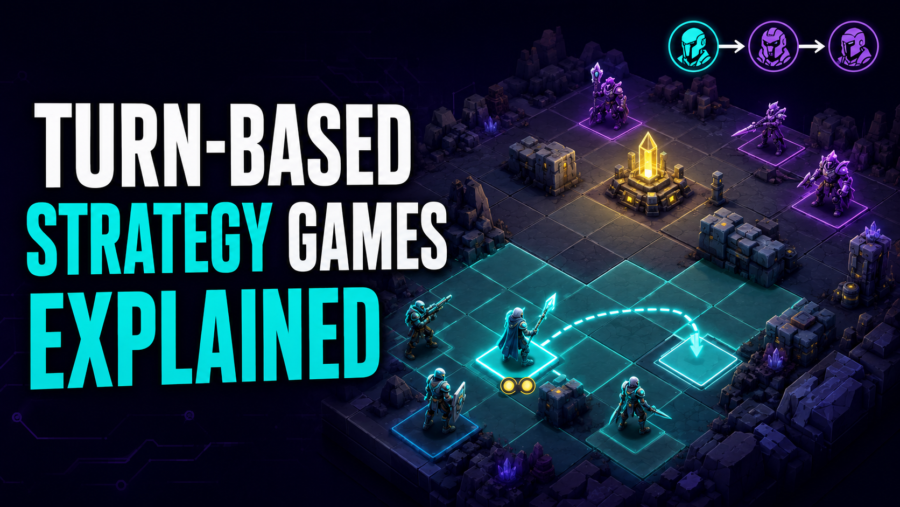
Turn-based strategy games divide play into discrete turns. A player, team, or unit receives an opportunity to act, makes one or more decisions, and then passes control according to the game’s turn order. The central challenge is planning within a limited action set rather than reacting continuously in real time.
Turns create room to inspect the current state, compare options, and anticipate later consequences. They do not automatically make a game easy. A single turn can contain many possible moves, resources, targets, and future responses.
What Makes a Strategy Game Turn-Based?
A game is turn-based when its important actions are organized into separate decision periods. During a turn, the rules identify who may act, which actions are legal, and when control moves on.
The structure can take several forms:
- One player completes a turn, then another acts.
- Individual units act according to an initiative order.
- Both sides plan actions, then the game resolves them together.
- A round ends only after every participant has acted.
- The player takes a turn, then the computer-controlled side responds.
The defining feature is not the length of the pause. It is the formal separation of actions into turns.
Turn-Based Strategy vs Real-Time Strategy
In a real-time strategy game, the world continues to update while the player makes decisions. Units can move, resources can accumulate, and opponents can act at the same time.
In turn-based strategy, the game state normally waits for the current decision or advances through controlled phases. This reduces reflex pressure but increases the importance of evaluating alternatives before committing.
| Turn-based structure | Real-time structure |
|---|---|
| Actions occur in discrete turns or phases | Actions unfold continuously |
| The player often has time to inspect the state | Delay can have an immediate cost |
| Turn order affects planning | Timing and simultaneous control are central |
| Action limits are often explicit | Attention and execution speed can become resources |
Hybrid designs can pause real-time play, resolve combat in turns, or use real time between turn-based encounters. Genre labels describe the dominant decision structure, not every second of play.
The Action Economy
The action economy is the amount and type of activity permitted during a turn. It determines what a player can accomplish before control passes.
A turn might allow:
- One move
- One move and one attack
- A fixed number of action points
- Any number of actions until a resource is exhausted
- One action for every available unit
- A main action plus smaller bonus actions
Action limits create tradeoffs. Moving into a strong position may consume the opportunity to attack. Using several cheap actions can be better than one expensive action, or the expensive action may create a decisive advantage.
A clear interface should show the remaining actions and explain which choices end the turn.
Turn Order and Initiative
Turn order determines when participants act. In a fixed order, the sequence repeats predictably. An initiative system can rank units by speed, attributes, random rolls, or another rule.
Initiative affects strategy because an action’s value depends on timing. A defensive move is less useful if the threat acts first. A delayed unit may be defeated or disabled before using its planned action.
Some systems reveal the full upcoming order. Others hide future positions or recalculate them each round. When the order is visible, manipulating it can become part of the strategy.
Alternating Turns vs Simultaneous Planning
Alternating turns give one side control at a time. The current player can react to the visible result of the previous turn.
Simultaneous planning asks participants to choose actions without seeing the other’s current choice. The game then resolves both plans together or according to a priority rule.
Simultaneous systems reduce some first-move advantages, but they introduce prediction and uncertainty. A plan may fail because the target moved, a route became blocked, or two actions interacted in an unexpected order.
Neither structure is inherently more strategic. They emphasize different kinds of reasoning.
Position, Range, and Terrain
Many turn-based strategy games use a grid, map, lane, or network of connected locations. Position affects which targets are reachable and which spaces are safe.
Common spatial rules include:
- Movement distance
- Attack range
- Line of sight
- Cover or defensive terrain
- Height differences
- Choke points
- Zones of control
- Hazards and blocked tiles
The map turns movement into a resource. Advancing may secure an objective but expose a unit. Holding a narrow route can reduce the number of directions an opponent can approach.
Not every turn-based strategy game uses units on a map. Card, economy, drafting, and abstract systems can create strategic turns through resources and rules instead of physical positioning.
Resources and Opportunity Cost
Strategy comes from limited choices. A player may manage currency, energy, action points, cards, units, time, or space.
Spending a resource on one option means delaying or giving up another. This is opportunity cost. A cheap improvement can solve the current problem, while saving may unlock a stronger long-term option.
Good strategic decisions connect short-term survival with long-term position. A move that wins the current exchange can still weaken the next round if it consumes every resource or leaves no response available.
This resource planning also appears in tower defense games, although their waves often advance in real time between building decisions.
Information: Perfect, Hidden, and Uncertain
The amount of visible information changes how a turn should be evaluated.
- Perfect information: The relevant state and legal options are visible to all sides.
- Hidden information: Opponents may hold unseen cards, units, objectives, or resources.
- Random outcomes: An action may have a probability of success, damage range, or variable result.
- Partial visibility: Parts of the map or future threats may be concealed.
Perfect information emphasizes calculation. Hidden information adds inference and risk management. Randomness does not remove strategy if players can estimate the risk and prepare for several outcomes.
Win Conditions and Objectives
Defeating every opposing unit is only one possible objective. A turn-based strategy game may instead ask the player to:
- Control specific locations
- Reach a destination
- Protect a unit or structure
- Survive for a number of rounds
- Gather or spend a target amount of resources
- Complete an objective before a turn limit
- Earn more points than an opponent
The objective changes the value of every action. An attack that is useful in an elimination match may waste time in a race for territory.
Turn-Based Strategy vs Turn-Based Tactics
“Strategy” usually describes broader planning across a larger system. It can include resource production, expansion, technology, diplomacy, or decisions that affect many later encounters.
“Tactics” usually describes smaller-scale decisions within a particular confrontation. Positioning, cover, target selection, and the use of a limited group of units are common tactical concerns.
The boundary is not strict. A game can contain a strategic layer between battles and a tactical layer during them. The useful question is whether the current decision concerns the wider campaign or the immediate encounter.
Turn-Based Does Not Mean Slow
A turn-based game can still impose a timer, short decision window, or rapid sequence of small turns. The rules remain turn-based because actions occur in discrete opportunities.
Likewise, a game without a timer can feel tense if every move has lasting consequences. Pace comes from the number of decisions, the amount of information, and the cost of mistakes, not only from clock speed.
Point-and-click games often allow deliberate thinking too, but they do not normally divide ordinary interaction into formal turns.
Single-Player, 1v1, and Team Formats
Turn-based systems can support one player against a programmed opponent, two players facing each other, teams, or several independent participants.
The mode affects turn order and information. A local pass-and-play format may reveal the same screen to every participant. Online asynchronous play can allow hours between turns. A cooperative mode can let players plan toward one shared objective.
Game Modes Explained separates single-player, co-op, local multiplayer, online multiplayer, and 1v1 structures.
Why Turn-Based Strategy Works in a Browser
A turn-based system can tolerate short pauses in input because the game is already organized around decisions. It can also fit a wide range of interfaces, from maps and cards to menus and simple grids.
That does not make every turn-based browser game technically lightweight. Graphics, simulations, online synchronization, and save systems can still be demanding. How HTML5 games work explains the technology separately from the genre.
Frequently Asked Questions
What is a turn in a strategy game?
A turn is a defined opportunity for a player, team, or unit to perform legal actions before control moves to the next participant or phase.
What are action points?
Action points are a limited resource spent on actions during a turn. Moving, attacking, using an ability, or interacting with an object may consume different amounts.
Is every strategy game turn-based?
No. Strategy games can be turn-based, real-time, simultaneous, or hybrid.
Are turn-based games always single-player?
No. They can support single-player, local multiplayer, online multiplayer, co-op, teams, or 1v1 competition.
Is a turn-based game the same as a board game?
No. Many board games use turns, but digital turn-based games can automate rules, calculations, hidden information, animation, and computer-controlled opponents.
Do platformers use turns?
Most platformers use continuous movement and timing rather than formal turns. Platformer mechanics focuses on traversal, jumping, and hazards.