
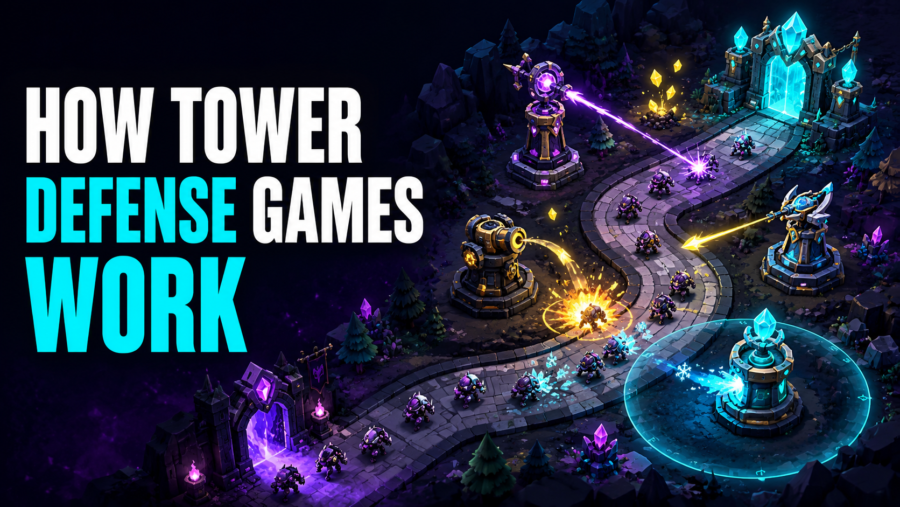
Tower defense games are strategy games in which players place or improve defensive units to stop waves of enemies from reaching a protected destination. The challenge comes from limited space, limited resources, enemy routes, and tradeoffs between different types of defense.
Most tower defense games share that structure, but their maps and rules can differ. Some use fixed paths, while others let placed defenses change the route. Some run continuously, while others pause between waves or use turn-based planning.
The Core Tower Defense Loop
A typical match follows this cycle:
- Inspect the map and enemy route.
- Spend a starting resource on defenses.
- Begin or receive an enemy wave.
- Earn resources by surviving, defeating enemies, or completing the wave.
- Build, upgrade, move, or sell defenses.
- Prepare for a stronger or different wave.
- Continue until the final wave is stopped or the protected objective fails.
The loop combines planning with adaptation. A layout that handles early enemies may struggle when later waves introduce speed, armor, range, flight, or resistance.
What Is Being Defended?
The destination can be a base, gate, object, character, resource, or abstract endpoint. Enemies try to reach it by following the game’s movement rules.
Failure can be measured in several ways:
- Each enemy that reaches the goal removes health.
- One successful enemy ends the level.
- Enemies steal a limited resource and attempt to escape.
- The player must protect several locations.
- Too many leaks reduce the final score without immediately ending play.
A “leak” commonly means an enemy passed the defenses and reached the protected area. The exact penalty depends on the game.
Towers and Defensive Units
“Tower” is a broad design term. The defensive object may look like a machine, character, trap, spell, plant, or another unit. What matters is its role in the defense system.
Important properties can include:
- Build cost
- Damage per hit
- Attack speed
- Range
- Target limit
- Projectile travel time
- Area of effect
- Accuracy
- Damage type
- Slow, stun, poison, or another status effect
- Minimum range
- Placement footprint
No single statistic tells the full story. A high-damage defense can perform poorly if it attacks too slowly, cannot reach the route, or wastes most of its damage on weak targets.
Damage, Attack Speed, and Damage per Second
Damage per second, often shortened to DPS, estimates sustained output.
If a tower deals 20 damage every 2 seconds, its simple average is 10 damage per second. If an upgrade raises the damage to 30 but keeps the same interval, the average becomes 15.
That calculation is only a starting point. Actual performance can change because of:
- Time spent waiting for a target
- Projectiles missing or arriving late
- Armor or resistance
- Overkill on low-health enemies
- Area damage hitting several targets
- Status effects
- Limited firing angles
A lower-DPS support tower can create more total value by slowing enemies inside the range of several other defenses.
Range and Placement
Range defines where a defense can affect the route. Placement determines how long enemies remain within that range.
A bend or loop can let one tower cover the same path for a longer period. A straight section may favor long-range attacks. A narrow area can improve splash damage if enemies group together.
Good placement considers:
- Length of route covered
- Number of paths reached
- Visibility or line of sight
- Nearby support effects
- Space needed for future towers
- Whether enemies can change direction
- Minimum and maximum range
The most expensive available position is not automatically the best one. Coverage and interaction matter more than price alone.
Fixed-Path and Open-Path Maps
Fixed-Path Tower Defense
Enemies follow a predetermined route. Towers are placed beside it or on designated spaces.
The player cannot change the path, so the main questions concern coverage, damage, timing, and upgrade order.
Open-Path or Maze-Building Tower Defense
Placed defenses can block spaces and redirect enemies. The layout becomes part of the pathfinding problem.
The rules usually require at least one legal route to remain open. A longer route gives towers more time to attack, but building the maze consumes space and resources.
Some games mix the models by providing several fixed lanes with limited blockers or gates.
Enemy Waves
A wave is a group or sequence of enemies released according to a schedule. Waves create readable stages of pressure and give the player a reason to prepare for changing threats.
Variation can come from:
- Enemy count
- Speed
- Health
- Armor or resistance
- Route
- Size
- Special abilities
- Spacing between enemies
- Several enemy types arriving together
A large group of weak enemies tests area coverage. A small group of durable enemies tests concentrated damage. Fast enemies test reaction time, range, and slowing effects.
Wave previews can make the challenge more strategic by revealing what comes next. Hidden waves place more emphasis on flexible defenses and learning through attempts.
The Tower Defense Economy
Resources limit how much defense can be built. Income may come from defeated enemies, completed waves, passive generation, objectives, or selling existing structures.
Every purchase has an opportunity cost. Spending on one upgrade delays another tower, and saving for an expensive option can leave the current wave under-defended.
Useful comparisons include:
- Immediate damage added per unit of cost
- New area of the map covered
- Support provided to existing towers
- Ability to counter the next enemy type
- Long-term scaling from an upgrade path
- Refund received if the choice is sold later
The highest long-term value is not always the correct purchase if the next wave will arrive before it pays off.
Building New Towers vs Upgrading Existing Ones
A new tower increases coverage and adds another attack source. An upgrade improves a tower already placed in a useful position.
Build a new tower when the defense has a coverage gap, needs another target, or must handle a second lane. Upgrade when an existing tower is attacking consistently and the improvement adds enough damage, range, speed, or utility.
Upgrade paths may branch. One branch can emphasize single-target damage while another improves range or area control. A branch choice can be permanent, so the interface should explain it before purchase.
Targeting Rules
A defense may attack the first enemy on the path, the last, the nearest, the strongest, the weakest, or a manually selected priority.
Targeting changes performance. Focusing the first enemy helps prevent a leak, while targeting the strongest may reduce a major threat before it reaches the final section.
Specialized towers may need specialized priorities. A slowing tower can spread its effect across several targets, while a high-damage tower may avoid wasting a large hit on an enemy with very little health.
If the game offers targeting controls, use them as part of the strategy rather than treating towers as completely automatic.
Support Effects and Combined Defenses
Not every tower is designed to deal direct damage. Support can include:
- Slowing enemies
- Increasing nearby attack speed
- Increasing range
- Revealing hidden targets
- Reducing armor
- Generating resources
- Moving or grouping enemies
- Blocking a route
The value of support depends on what it affects. A percentage boost can become stronger when several powerful towers are inside its area.
This creates combinations. Slowing enemies near area damage can keep a group inside the attack zone longer. Armor reduction can increase the value of several fast attackers.
Selling and Rebuilding
Selling returns some portion of a tower’s cost in many, but not all, games. It can correct a poor placement, fund an urgent counter, or move resources to a later part of the route.
The refund rate matters. Frequent rebuilding can lose resources if every sale returns less than the original cost.
Before selling, compare the immediate benefit with the lost coverage and refund penalty.
Common Tower Defense Mistakes
Spending Everything Before Seeing the Threat
Using every resource immediately leaves no response to a new enemy type. A small reserve can protect against surprises.
Building Only One Damage Type
A uniform defense can fail against resistance, armor, speed, or target rules. A mixed layout is often more adaptable.
Ignoring Coverage
An upgraded tower contributes nothing while enemies are outside its range. Position and uptime matter.
Over-Upgrading One Location
Concentrating all value in one area can leave another lane or the final approach exposed.
Forgetting the Win Condition
Defeating many enemies is not enough if a few fast ones reach the objective. Build for the actual failure rule.
Tower Defense vs Turn-Based Strategy
Tower defense belongs to the broader strategy family, but it is often real-time during waves. The player may build while enemies move or plan during pauses.
A turn-based strategy game separates important actions into formal turns. A tower defense game can use turns, but the genre does not require them.
Tower Defense and Incremental Progression
Tower upgrades create growth within a match, and some games add persistent upgrades between levels. That does not automatically make the game incremental.
In an incremental game, expanding production and repeated numerical growth form the central loop. Tower defense centers on stopping movement through a defended space.
The genres can overlap when resource production and long-term automation become major systems.
Single-Player, Co-op, and Competitive Tower Defense
Tower defense can support several modes. A single player may control the whole layout. Co-op players may share resources or defend separate lanes. Competitive players may send threats, race for score, or attack opposing defenses.
The presence of multiple lanes or several on-screen defenders does not prove multiplayer. Game Modes Explained identifies the human-participant structure separately from the genre.
Daily Tower Defense Challenges
A daily challenge can fix the map, wave order, starting resources, or allowed tower types for one date. Fair comparison requires the same rules and settings.
Frequently Asked Questions
What is the main goal of a tower defense game?
Stop enemies from reaching or destroying a protected destination by placing and improving defenses.
What is a wave?
A wave is a scheduled group or sequence of enemies. Later waves often add more enemies, stronger statistics, or different abilities.
What does DPS mean?
DPS means damage per second. It estimates sustained output, but range, targeting, armor, overkill, and area effects can change real performance.
What is a leak?
A leak is an enemy that passes the defenses and reaches the protected objective. The penalty can be lost health, resources, score, or the entire level.
Do all tower defense games use fixed paths?
No. Some use fixed routes, while others allow defenses to redirect enemies or create a maze.
Are tower defense games always real-time?
No. Many run waves in real time, but some pause for planning, use turns, or combine several timing models.