
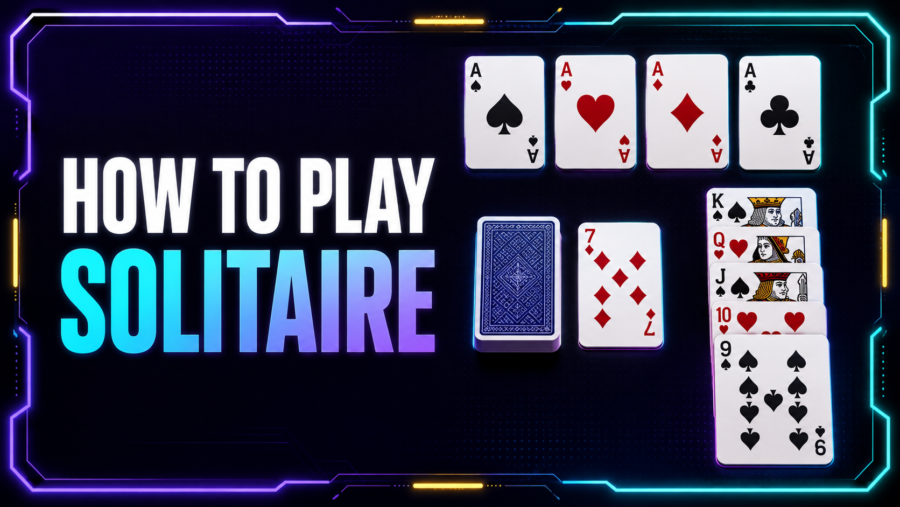
To play the form of solitaire most people mean in a browser, arrange a standard 52-card deck into seven tableau columns, move cards in descending order with alternating colors, and build four foundation piles from Ace to King by suit. You win when all 52 cards reach the foundations.
This version is called Klondike solitaire. “Solitaire” is also a broad name for many one-player card games, so another version may use different layouts and rules.
The Parts of a Solitaire Layout
A Klondike layout has four main areas.
| Area | Purpose |
|---|---|
| Tableau | Seven columns where most movement and uncovering happens |
| Foundations | Four piles built upward by suit from Ace to King |
| Stock | The undealt cards waiting to be drawn |
| Waste | The face-up cards drawn from the stock |
Understanding these names makes rule instructions much easier to follow.
How to Set Up Solitaire
Use one standard 52-card deck without jokers.
Deal seven tableau columns from left to right:
- The first column receives 1 card.
- The second receives 2 cards.
- Continue until the seventh column receives 7 cards.
- Turn only the top card of each column face up.
- Keep every card beneath it face down.
The tableau uses 28 cards in total. Place the remaining 24 cards face down as the stock. Leave space near the stock for the waste and space for four foundation piles.
Digital versions prepare the layout automatically, but the same structure remains underneath.
The Goal of Klondike Solitaire
Move every card to the four foundations. Each foundation belongs to one suit and must be built in ascending order:
Ace, 2, 3, 4, 5, 6, 7, 8, 9, 10, Jack, Queen, King.
For example, the 5 of hearts can go only on the 4 of hearts. A red 5 cannot be placed on a black 4 in a foundation because foundation cards must match suit and rise in rank.
How to Build the Tableau
Tableau cards are placed in descending rank with alternating colors.
Examples of legal moves include:
- A red 8 onto a black 9
- A black 7 onto a red 8
- A red Queen onto a black King
Examples of illegal moves include:
- A red 8 onto a red 9 because the colors do not alternate
- A black 9 onto a red 8 because the rank is moving upward
- A black 7 onto a red 9 because the ranks are not consecutive
Suits do not have to alternate in the tableau. Only color and descending rank matter there.
Moving a Sequence of Cards
When face-up cards already form a correct descending, alternating-color sequence, the sequence can normally move together to another legal tableau card.
For example, a black 7, red 6, and black 5 can move as a group onto a red 8. This preserves the required order.
Some physical rule descriptions and digital variants differ on exactly which partial sequences may move. Follow the interface’s highlighted legal moves if a particular version rejects a sequence.
Turning Over Hidden Cards
When the last face-up card leaves a tableau column and exposes a face-down card, turn the newly exposed card face up.
Revealing hidden cards is one of the main sources of progress. A move that uncovers a card usually provides more information and creates new options.
If a face-down card remains covered, it cannot be moved or used.
Empty Tableau Columns
Only a King can normally enter an empty tableau column. A correctly arranged face-up sequence beginning with a King can also move into that space.
Empty columns are valuable because they let long sequences move and expose new cards. However, creating an empty column helps only if a useful King or King-led sequence can fill it.
How Foundations Work
Start each foundation with an Ace. Build upward in the same suit until the King is placed.
Aces and low cards are often safe to move early, but sending every available card to the foundation immediately can restrict the tableau. A card on the foundation may still be needed temporarily to build an alternating sequence below another card.
Some digital versions allow a foundation card to return to the tableau. Others restrict or discourage that move. Check the exact controls before relying on it.
How to Use the Stock and Waste
When no useful tableau move is available, draw from the stock to the waste. Only the top visible waste card is available for play.
Two common draw rules exist:
Draw One
Turn over one stock card at a time. This exposes every card in sequence and is generally easier to manage.
Draw Three
Turn over three cards at a time, with only the top card of the group available. Playing that card can expose the card beneath it.
Draw-three requires more planning because the order of available waste cards changes as cards are removed.
Can the Stock Be Reused?
Redeal rules vary. A version may allow unlimited passes through the stock, permit only a fixed number of passes, or allow no redeal at all.
Do not assume that the waste can always be turned over again. Check the mode before planning around repeated passes.
When recycling is allowed, the waste is normally turned over without shuffling so its order remains meaningful.
A Complete Turn-by-Turn Method
Use this process when learning:
- Move any available Aces to the foundations.
- Look for tableau moves that expose a face-down card.
- Build descending alternating-color sequences.
- Turn over every newly exposed tableau card.
- Use a King or King-led sequence when a column becomes empty.
- Move suitable cards to the foundations when doing so does not block a needed tableau move.
- Draw from the stock when no productive tableau move remains.
- Recheck every column after a waste-card move because new combinations may now exist.
- Continue until all cards reach the foundations or no legal move remains.
The game is won only when every suit is complete from Ace through King.
Solitaire Strategy for Beginners
Prioritize Hidden Cards
A move that reveals a face-down tableau card usually creates more value than one that only rearranges visible cards. Hidden cards contain the information and options needed to complete the game.
When two legal moves are available, compare which one uncovers a card sooner.
Do Not Empty a Column Without a Plan
An empty column is powerful, but only Kings can fill it. Before creating the space, identify which King or sequence will move there and what that move will reveal.
Build Both Colors
If every useful red card is trapped under another red card, the tableau can stall. Maintaining access to both red and black ranks creates more alternating sequences.
Use the Stock Order
In draw-three, notice which cards appear together. Playing one waste card changes which card becomes available on the next pass.
Random clicking can disturb a useful sequence of access. Pause before taking a card simply because it is legal.
Avoid Rushing High Cards to Foundations
Moving a high card to a foundation can remove a useful support card from the tableau. Consider whether a lower card of the opposite color still needs it.
Reveal the Largest Hidden Columns
The rightmost tableau columns begin with more face-down cards. Opening them often requires more planning and should not be postponed indefinitely.
Why Some Solitaire Deals Cannot Be Won
Not every deal is guaranteed to be solvable under every rule set. Important cards can remain inaccessible because of the initial order, stock rule, or an earlier decision.
A loss does not always prove that the deal was impossible. A different sequence of legal moves can change which cards become available.
Undo and restart features help test alternatives, but they are optional interface tools rather than universal rules.
Common Digital Solitaire Features
A browser version may add:
- Undo
- Hints
- Automatic moves to foundations
- Draw-one and draw-three modes
- Timers
- Move counters
- Scoring systems
- Winnable-deal options
- Daily layouts
These features can change how a result is measured without changing the core tableau and foundation rules.
A browser version is still delivered through the web rather than defined by a special solitaire technology. How HTML5 games work explains loading, browser storage, and why a separate installer is normally unnecessary.
How Solitaire Scoring Works
There is no single universal scoring system. A digital version may award points for revealing cards, moving cards to foundations, speed, few moves, or completing the deal.
Another version may record only wins and losses. A score from one ruleset may not be directly comparable with a score from another.
Is Solitaire Always Single-Player?
Solitaire means a game designed for one player, but results can still be compared through leaderboards, daily challenges, or separate races.
Those comparisons do not change the underlying mode unless participants directly share a match. The difference is covered in Game Modes Explained.
Frequently Asked Questions
Is solitaire the same as Klondike?
Klondike is one type of solitaire and the version most commonly meant by the unqualified name. Many other solitaire games use different layouts and building rules.
How many cards are in the tableau?
The seven columns contain 28 cards in total. The remaining 24 begin in the stock.
What card can go into an empty column?
Normally only a King or a correctly ordered sequence beginning with a King.
Do tableau cards have to match suit?
No. They descend by rank and alternate red and black. Foundation cards must match suit and rise from Ace to King.
Can the waste be recycled into the stock?
That depends on the version. Some allow unlimited passes, some limit the number, and some allow none.
When is solitaire won?
The game is won when all 52 cards have been moved to the four suit foundations in order from Ace through King.