
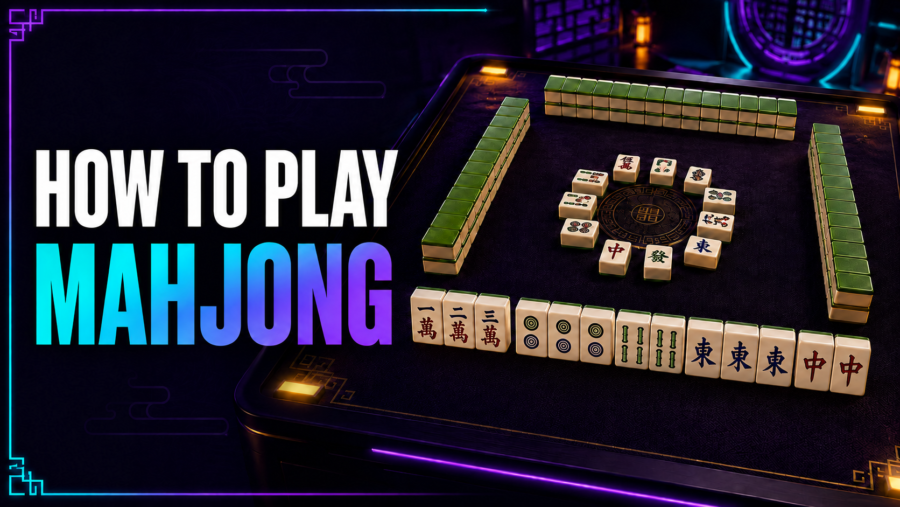
Mahjong is usually played by four people who draw and discard tiles while trying to complete a winning hand. In many widely used 13-tile rule sets, a standard winning hand contains four groups and one pair, for 14 tiles in total.
That is the common core, not a complete universal rulebook. Chinese, Japanese, American, and other regional forms use different tile sets, setup procedures, legal hands, claim rules, and scoring. Choose one ruleset before play and use its details consistently.
Mahjong and Mahjong Solitaire Are Different Games
Traditional mahjong is a multiplayer draw-and-discard game. Players build a hidden hand, watch the discards, and may claim certain tiles under the selected rules.
Mahjong solitaire is a single-player matching puzzle. Tiles begin stacked in a layout, and the player removes matching exposed pairs. It uses mahjong-style tiles but does not use the same turn structure or hand-building rules.
This guide covers traditional four-player mahjong at a general beginner level.
The Main Mahjong Tiles
Most common sets contain three numbered suits:
- Characters: Numbered 1 through 9
- Bamboo: Numbered 1 through 9
- Dots or circles: Numbered 1 through 9
Each numbered tile normally appears four times.
Honor tiles include:
- Four winds: East, South, West, and North
- Three dragons: Red, Green, and White
Some sets and rules also use flower and season tiles. These are handled separately and often require a replacement draw. American mahjong uses additional conventions and a published hand card, so its procedure differs substantially from the common four-groups-and-a-pair structure described here.
The Goal of Mahjong
The immediate goal is to complete a legal winning hand before the other players.
In many 13-tile forms, players hold 13 tiles between turns. A player draws or claims a tile to reach 14, then either declares a win or discards back to 13.
A standard winning hand normally contains:
- Four groups, also called sets or melds
- One pair of identical tiles
The groups can be sequences, triplets, or quads as permitted by the rules.
Special winning hands can break the four-groups-and-a-pair pattern. Their availability and value depend entirely on the chosen ruleset.
The Three Basic Groups
Chow: A Sequence
A chow is three consecutive numbered tiles in the same suit.
Examples include 2-3-4 of Bamboo or 6-7-8 of Dots.
Winds and dragons cannot form a chow because they have no numerical sequence. A sequence also cannot cross from 9 back to 1.
Pung: A Triplet
A pung is three identical tiles, such as three 5 of Characters or three Red Dragons.
Any suited or honor tile can form a pung when three matching copies are available.
Kong: A Quad
A kong is four identical tiles. It counts as one group even though it uses four physical tiles.
Declaring a kong normally requires drawing a replacement tile so the rest of the hand can still reach the required structure. The timing, exposure, replacement draw, and scoring rules differ between variants.
The Pair
A standard hand also needs two identical tiles as its pair. The pair cannot be a sequence or two merely related tiles.
Some pairs have extra scoring value under particular rules. A pair that completes the hand is still only one pair, not a pung.
Basic Setup
The exact dealing procedure varies, but a common physical setup follows this outline:
- Turn the active tiles face down and mix them.
- Build a wall of stacked tiles in front of each player.
- Use the chosen rule’s dealer and wall-break procedure.
- Deal 13 tiles to each player.
- Give the dealer an additional tile so the dealer begins with 14 and makes the first discard.
Flower, season, dead-wall, dice, and replacement procedures are ruleset-specific. Do not combine details from several variants without agreeing on them first.
The Basic Turn
After the opening discard, ordinary play follows a draw-and-discard rhythm:
- Draw the next available tile from the wall.
- Check whether the 14 tiles form a legal winning hand.
- If not, choose one tile to discard face up.
- Play passes according to the ruleset’s seat order.
The hand normally returns to 13 tiles after the discard.
The sequence can be interrupted when another player legally claims the most recent discard for a group or a win.
Claiming a Discard
Claim rules vary, but common forms allow a recent discard to be taken for a chow, pung, kong, or winning hand.
Typical restrictions include:
- A chow can usually be claimed only by the next player in turn order.
- A pung or kong may be claimable by a wider set of players.
- A winning claim usually has priority over a claim for an ordinary group.
- The claimed tile and completed group are normally exposed in front of the player.
Priority rules can become complicated when several people want the same discard. Follow the selected ruleset instead of relying on a general summary.
Concealed and Exposed Groups
A concealed group is formed entirely from tiles drawn into the hand and remains hidden until the hand is shown.
An exposed group is revealed after claiming another player’s discard. Exposing a group gives opponents information and can affect scoring.
Claiming every available group is not always useful. A claim changes turn order, reveals part of the plan, and locks those tiles into a fixed group. Keeping a hand concealed can preserve flexibility.
How a Hand Wins
After drawing or legally claiming a tile, check whether the hand satisfies both requirements:
- Its structure is legal under the ruleset.
- It meets any minimum scoring or pattern requirement.
The second point is important. Some forms allow any basic complete hand, while others require at least one qualifying pattern or a minimum value before a win can be declared.
Do not assume that four groups and a pair are sufficient in every variant.
How Mahjong Scoring Works
Mahjong does not have one universal scoring table. Different rules reward different patterns, methods of winning, concealed groups, special tiles, seat positions, or repeated rounds.
Before starting, agree on:
- The ruleset
- Which tiles are active
- The minimum requirement to win
- The list of scoring patterns
- How a self-drawn win differs from a discard win
- How payments or points are calculated
- How dealer continuation works
- How drawn hands are handled
A beginner session can use a simplified scoring system, but all players should use the same one.
Beginner Mahjong Strategy
Build Flexible Shapes
Connected numbered tiles can support several possible sequences. For example, a small run of neighboring values may accept more useful draws than isolated tiles.
Flexibility matters because the exact winning tile is not known in advance.
Remove Isolated Tiles Carefully
An honor tile with no matching copy and a numbered tile far from the rest of the hand can be difficult to use. These are common discard candidates.
However, visible discards matter. If several copies of a tile are already out, keeping the remaining copy for a triplet may be unrealistic.
Watch the Discard Pool
Discarded tiles provide information about availability and possible danger. They can show that a needed tile is nearly exhausted or suggest which suits another player is avoiding.
Do not assume that one discard reveals a complete strategy. Use repeated patterns and exposed groups as stronger evidence.
Keep More Than One Route to Completion
A hand that depends on one exact tile can stall. Several possible sequences, pairs, or triplets create more winning draws.
As the hand gets closer to completion, count which tiles can finish it and how many copies remain unseen.
Think Before Claiming
Claiming a discard can complete a useful group, but it also exposes information and can reduce future options. Consider whether the claim improves the hand enough to justify that commitment.
Learn One Ruleset First
Mixing terms and scoring rules from several variants creates confusion. Learn the turn flow, legal groups, and basic win requirement of one system before comparing others.
What Is a Ready Hand?
A ready hand is one tile away from a legal win. The player may be waiting for one tile type or several.
The number of possible winning tiles depends on the shape of the incomplete groups and pair. A wider wait generally creates more chances, but visible discards can reduce the number of copies still available.
Some rulesets require or reward a formal ready declaration. Others do not use that procedure.
What Happens When the Wall Runs Out?
If no player wins before the drawable wall is exhausted, the hand normally ends in a draw. The scoring, penalties, dealer status, and next-hand procedure depend on the ruleset.
An exhausted wall is not the same as a tied score. It means the current hand ended without a normal winner.
Mahjong in a Browser
A digital version can shuffle, deal, enforce legal claims, calculate scores, and display turn order automatically. That convenience does not erase ruleset differences.
Before playing, check whether the digital game is traditional multiplayer mahjong or single-player mahjong solitaire. Also identify the named rule variant, player count, scoring requirement, and whether opponents are human or computer-controlled.
The game modes guide explains why playing against computer-controlled seats is still a single-human mode, while remote human seats create online multiplayer.
Browser versions may save settings or match history locally or through an account. How HTML5 games work explains the difference between browser storage and account-based data.
Daily Mahjong Challenges
A daily challenge can assign a specific hand, puzzle, scoring goal, or tile layout to a date. It may be traditional mahjong, a solo practice problem, or mahjong solitaire.
These are different experiences even when they use the same tile symbols. Check the objective before relying on traditional four-player rules.
Frequently Asked Questions
How many people play mahjong?
Traditional mahjong is most commonly played by four people, but three-player and other variants exist.
How many tiles are in a winning hand?
In many common 13-tile rules, a standard win is completed with 14 tiles: four groups and one pair. Kongs and special hands require careful counting under the chosen ruleset.
What is the difference between a chow and a pung?
A chow is a three-tile numerical sequence in one suit. A pung is three identical tiles.
Can honor tiles form a sequence?
No. Winds and dragons can form matching groups but not numbered chows.
Can any player claim a tile for a chow?
In many common rules, only the next player in turn order can claim a discard for a chow. Exact claim and priority rules vary.
Is mahjong solitaire the same as mahjong?
No. Mahjong solitaire is a single-player exposed-pair matching puzzle. Traditional mahjong is a multiplayer draw-and-discard game with hands, groups, and variant-specific scoring.