
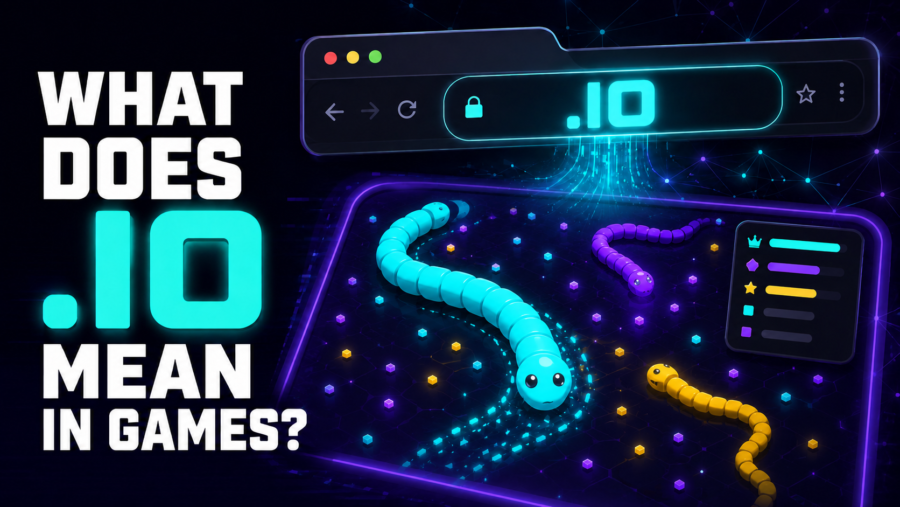
In games, “.io” began as a website address ending and developed into an informal label for a style of accessible browser game. It is not a game engine, a graphics technology, or an official genre with fixed rules.
Many .io games use quick entry, simple controls, shared arenas, visible opponents, and short competitive rounds. Those traits are common conventions, not guarantees. A game can use “.io” in its name without matching all of them.
What Is the .io Domain?
.io is a country-code top-level domain, or ccTLD. A top-level domain is the ending of a website address, such as .com, .org, or a two-letter country code.
The official Internet Assigned Numbers Authority record classifies .io as the country-code domain for the British Indian Ocean Territory. It was registered in 1997.
Technology companies also adopted .io because the letters are commonly read as “input/output” in computing. That interpretation is a convenient association, not the official meaning of the country-code domain.
How .io Became a Game Label
Browser games using short .io addresses became widely recognizable as a group. Players began using “.io game” to describe not only the address but also a familiar play pattern: open a page, enter a match quickly, learn a small control set, and interact with other players in a shared space.
As the label spread, it became less precise. A game might be described as .io because it uses similar mechanics even if its current address does not end in .io. Another website can use a .io address while hosting software, documentation, or a service unrelated to games.
The suffix therefore has two meanings that should be kept separate:
- A literal website address ending in .io
- An informal browser-game style associated with that suffix
Common .io Game Mechanics
No feature is mandatory, but several patterns appear often.
Fast Entry
The player can usually reach the main interaction quickly. A short name field, mode choice, or basic tutorial may appear before play.
Fast entry suits browser sessions because it reduces the distance between opening the page and understanding the first action.
Simple Inputs
Movement and one or two actions are common. A compact control scheme makes it easier to join without studying a long manual.
Simple input does not mean shallow play. Positioning, timing, prediction, and awareness of other players can create complexity from a small set of controls.
Shared Arenas
Many .io-style games place several participants in one bounded map or connected play space. Players can see movement, competition, or changes caused by others.
A shared arena normally requires some form of network synchronization. The server or networking system must communicate important state changes between participants.
Short Rounds or Repeated Runs
Failure may return the player to a lobby, restart screen, or new run. Quick repetition makes it possible to learn from an encounter and try again without a long setup.
Not every .io game uses formal rounds. Some have persistent sessions where players join and leave while the shared world continues.
Growth During a Session
A player may become larger, faster, stronger, better equipped, or more influential during one run. That growth can come from collecting resources, completing actions, or defeating opponents.
Session growth is usually temporary. It may reset when the run ends. This differs from incremental game progression, where upgrading a production system is the central loop and may persist across long periods.
Leaderboards
A leaderboard can show scores, size, survival, or another current result. It gives players a quick picture of their relative position.
A leaderboard alone does not prove direct multiplayer interaction. A single-player game can upload scores after a run. The distinction depends on whether participants affect the same live game state.
Are All .io Games Multiplayer?
No. Multiplayer is strongly associated with the label, but the domain suffix cannot guarantee a game mode. A developer can create a single-player game at a .io address, and a multiplayer browser game can use another domain.
Even within multiplayer, the structure can vary:
- Free-for-all competition
- Team competition
- Cooperative objectives
- Local play on one device
- Online play between remote devices
- Asynchronous score comparison
Game Modes Explained shows why multiplayer, co-op, 1v1, local, and online are separate claims.
Does .io Mean a Game Is Real-Time?
Not necessarily. Many recognizable .io-style games update continuously, but the label does not require real-time play.
A browser game could use turns, rounds, asynchronous actions, or a mixture. The exact rules determine whether decisions happen continuously or in separate turns.
Are .io Games Made With HTML5?
Many modern browser games use standard web technologies, but “.io” does not identify how a game was built. It is possible to use JavaScript, Canvas, WebGL, Web Audio, WebAssembly, or another combination.
What Are HTML5 Games? explains the delivery technology. HTML5 and .io answer different questions:
- HTML5: How can the browser run the game?
- .io: What domain ending or informal style is associated with the game?
Does .io Mean No Download Is Needed?
No separate installer is common for browser games, but the suffix itself promises nothing. The browser still has to download code and assets from the website before play.
A .io address could also lead to a normal website, a downloadable application, or a non-game service. Always judge the actual page and its requirements.
Why Can a .io Game Lag?
Two different performance problems can look like lag:
- Rendering slowdown: The device or browser struggles to draw and update the game smoothly.
- Network delay: Information takes longer to travel between the player and a remote server.
Closing heavy tabs may help a rendering problem but cannot fix a distant or overloaded server. Improving the connection may reduce network delay but will not solve an unsupported graphics feature.
If the page is blank, frozen, or displaying a WebGL error, follow Browser Game Not Loading Fixes. If the game runs smoothly but other players appear to jump between positions, the network path is more likely to be involved.
.io Games vs Browser Games
“Browser game” is the broader term. It covers any game intended to run through a web browser, including single-player puzzles, platformers, card games, strategy games, dress-up games, and multiplayer arenas.
“.io game” is narrower and less formal. It points either to a domain ending or to a group of design conventions that became associated with certain browser multiplayer experiences.
Every .io game delivered through the web can be a browser game, but most browser games are not meaningfully described as .io games.
Frequently Asked Questions
Does .io stand for input/output?
Not officially. .io is a country-code top-level domain. “Input/output” is a popular computing association that helped make the letters attractive to technology projects.
Is .io a game engine?
No. It does not create graphics, physics, networking, or controls. It is a domain suffix and an informal style label.
Does a game need a .io address to be an .io-style game?
Not always in common usage. Some people apply the style label to games with similar short-session browser multiplayer mechanics. That use is informal.
Are .io games always online multiplayer?
No. Multiplayer is common, but the suffix does not guarantee it. Verify the exact game’s mode.
Is every .io website a game website?
No. The domain is used by many kinds of websites and services.
Do .io games work on phones?
Only if the specific game supports the device, screen, browser, and touch controls. The domain name does not establish mobile compatibility.